
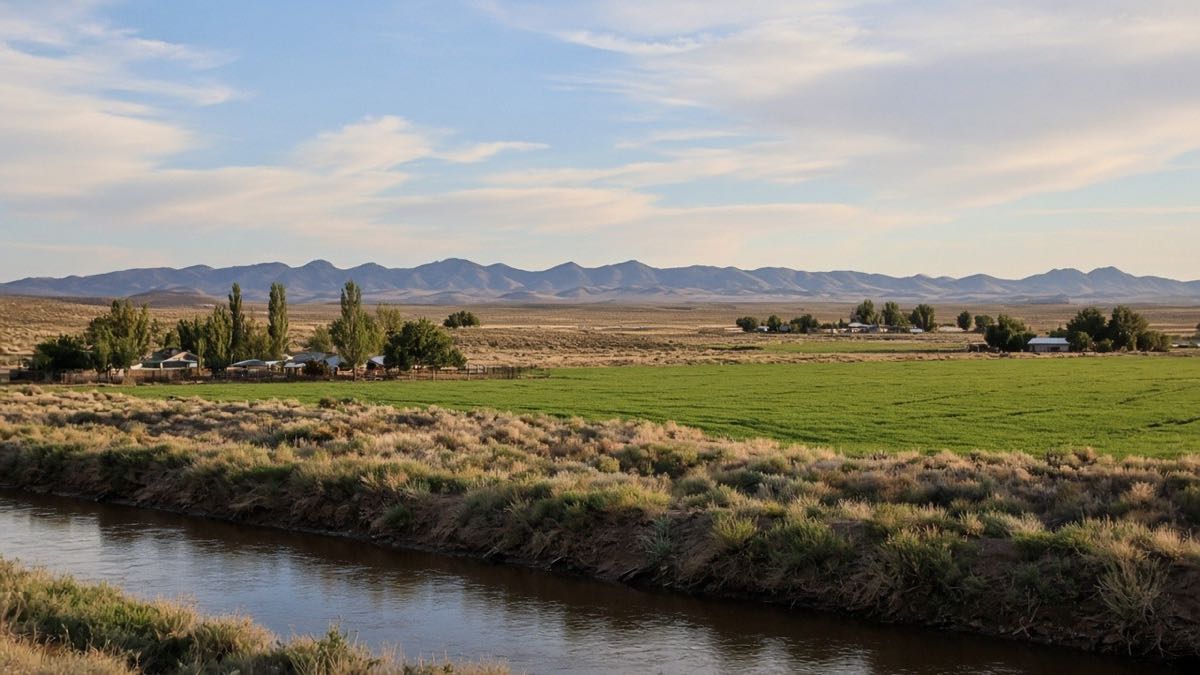
Fallon sits on the Lahontan Valley floor, where a lot of homes still pull drinking water from a private well. That well is not the City of Fallon system, and it is not Naval Air Station Fallon’s treated supply. Nevada does not regulate domestic wells the way it regulates a public water system. If you are on a well here, the chemistry under your lot is yours to find out.
City customers in Fallon drink water that goes through a municipal treatment plant built after the federal arsenic standard dropped to 10 parts per billion. NAS Fallon did the same for base housing. Private wells never got that plant. Slightly more than half of Churchill County residents were on domestic wells when researchers last counted the split, and that is still the split that matters: treated municipal water on one side of the road, an unregulated well on the other.
What we see in Churchill County
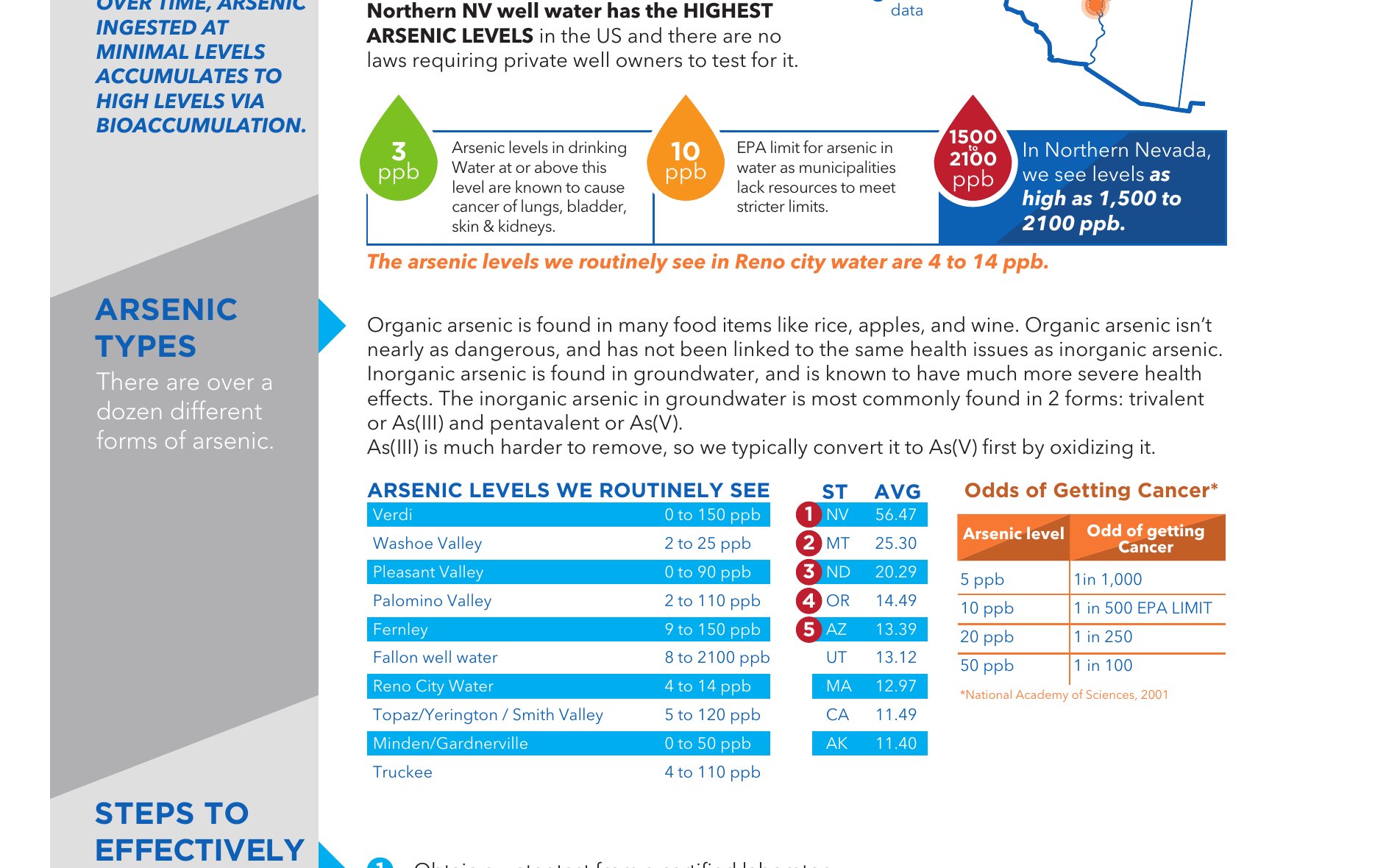
Wells Pure Water tests around Fallon routinely land between 8 and 2,100 parts per billion. That is the range on our Northern Nevada infographic, and it is the widest band we publish for any town we serve.
It also matches a public household survey. In 2002, researchers sampled tap water at 351 Churchill County homes on private wells. The minimum was below 3 ppb. The median was 26 ppb. The maximum was 2,100 ppb. Seventy-four percent of those samples exceeded the EPA’s 10 ppb limit. Only about 38% of well households in that survey were treating their water at all. Those numbers are from the published Churchill County study, not from our shop log — two samples, same valley.
People still ask whether arsenic caused the childhood leukemia cluster that put Fallon on the national news. The CDC investigation found arsenic was already high in Churchill County wells. It did not find that wells used by families in the cluster were higher than other local domestic wells. We are not here to diagnose that history. We are here to test the water you drink now.
A neighbor’s well is a different pocket
Lahontan Valley groundwater is not one tank. Two ranches a half-mile apart can sit on different alluvial pockets. One well finishes at 80 feet and tests under 10 ppb. The next finishes deeper, hits a reducing zone, and comes back at hundreds. Borrowing a neighbor’s lab sheet, or assuming the city CCR describes your well, is how families here skip a test for years.
The short science
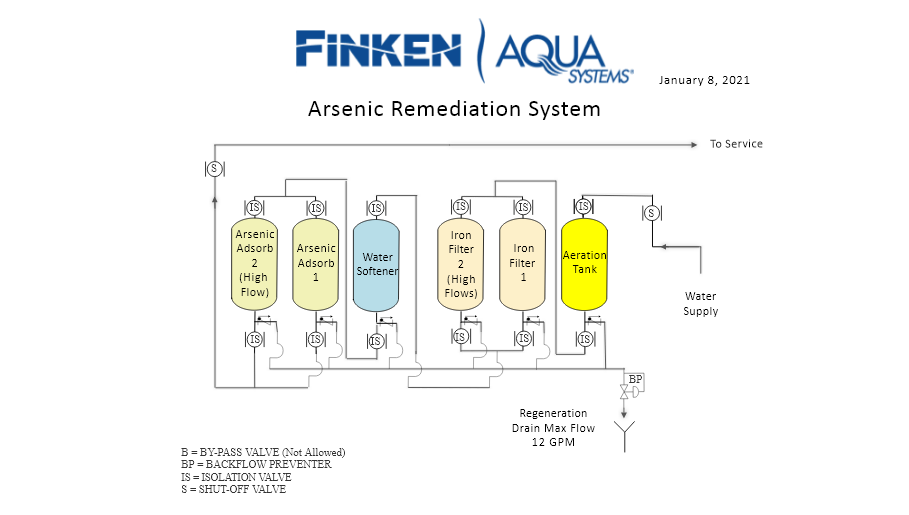
The EPA drinking-water limit is 10 ppb. Desert Research Institute’s 2022 study of 174 Northern Nevada private wells — most around Reno, Carson City, and Fallon — found 22% over that limit. In Pure Water’s own tests, 58% of the wells we are called out to test exceed 10 ppb. Those are two different groups. Inorganic arsenic usually shows up as As(III) or As(V); type III is harder to remove, so we typically oxidize it first. Iron and other metals can block arsenic media. Staging and lab work live on our Arsenic Awareness Month page rather than in this article.
If you are on NAS housing or a private well
“Arsenic treatment is not one-size-fits-all. It must be properly tested, designed, and installed to perform correctly.”
Bryce Pollock, managing partner
For NAS-associated families we have installed more than 1,180 reverse osmosis systems. That number is Fallon-specific. RO is one tool; it is not automatic for every Churchill County well. City of Fallon customers should read the city’s Consumer Confidence Report for the treated municipal supply. If your house is on a domestic well — including a well that used to be “fine” when the federal limit was 50 ppb — get a certified laboratory arsenic test. Hardware-store strips do not count.
Get a free certified lab arsenic test
If you drink a Churchill County well, or you have never tested since you bought the house, start with a lab result. October is Arsenic Awareness Month. Call (775) 324-2001 or request a free certified lab arsenic test.
Pure Water Systems of NV. 245 Vine St, Reno, NV 89503. NV Lic #94724. CA Lic #1054103.