
We often get the question: what kind of salt do I need for my water system?
The answer varies depending on your incoming water quality and the type of system you have. Depending on your water, you may see benefits from certain salts that justify the extra cost, while other options can cost five times as much and provide no benefit at all. Some options are also more prone to bridging, which is a hassle with little upside.
We keep water softener salt and potassium in stock at our Reno warehouse, and we offer delivery and fill services during service months depending on your location across Reno, Sparks, Carson City, Dayton, Gardnerville, Minden, Fernley, Fallon, Truckee, and Lake Tahoe.
Depending on where you live, plenty of local retailers stock softener salt as well: Home Depot, Lowe’s, Ace Hardware, Kruse’s Feed, Sierra Feed, Western Big R, Smith’s, Walmart, and Raley’s.
How Much Salt Do I Put In?
Water systems use a preset amount of salt regardless of how much is in the tank. Two gallons of water will only dissolve about 6 lbs of salt before becoming a saturated solution, so if your system needs 6 lbs to clean itself, it automatically puts two gallons into the brine tank before regenerating.
For that reason we tell people to treat the salt tank like the gas tank in your car. Don’t let it run completely out, but when it’s low you can fill it and forget about it for a while.
The exception is additive pellets and potassium. Because these tend to bridge, you may want to add only a couple of bags at a time. If your water use is high enough, or your water quality poor enough, it may not matter because you’ll go through it fast. But if you only use four bags a year and want to run pellets or potassium, it’s better to add two bags twice a year than four bags once.
What Is Bridging?
Bridging is when the salt forms one large chunk that water can’t reach and dissolve, so the system stops consuming salt and your water quality deteriorates.
It happens more in older systems that keep water in the brine tank constantly. Newer systems only add water the night before a regeneration, so the salt has less time to fuse. Bridging is also more common where temperatures swing, outdoor installations dissolve more salt when it’s hot, then the salt precipitates as temperatures drop, forming a chunk. In our area most installations are in insulated garages with consistent temperatures, so there’s less risk.
It’s good practice when adding salt to stir and break up whatever is left in the brine tank. A broom handle or a short length of PVC pipe works well.
Solar Salt
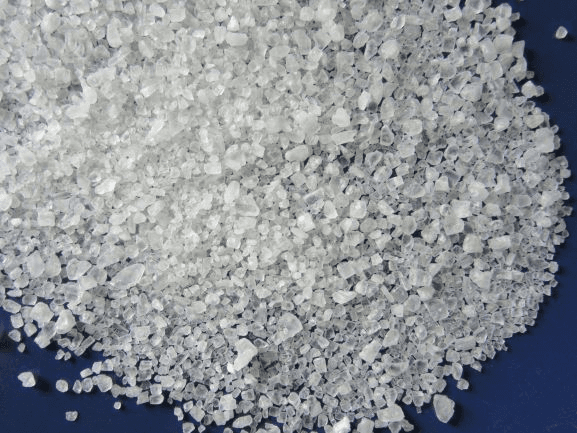
Pure sodium chloride (NaCl) in crystal form. The name comes from how it’s made: saline solution is flooded onto a salt flat, the sun evaporates the water, and the remaining NaCl crystals are collected and processed to a uniform size.
This is the best option for most of our customers, who are on city water with no iron or manganese requiring cleaning agents. Solar salt is inexpensive and you can fill the brine tank because it doesn’t bridge as easily. Many of our customers only add 200 lbs once per year.
- Less prone to bridging
- Lowest cost option
- Most noticeable silky feel
Additive Pellets
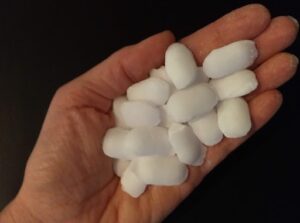
NaCl ground and pressed into uniform pellets with additives to clean the resin bed. Pellets take the solar salt option and add cleaners that remove what NaCl alone won’t, iron and manganese in particular. That can help if you’re on a well, where your softener likely sees small amounts of iron. However, we’ve found the binding agent used to form the pellets increases bridging.
The cleaning agents can also harm certain treatment units. Our Evolve and Water Right Sanitizer units use a zeolite-based resin called Crystal-Right (CR100 and CR200), which is designed to remove iron and manganese, and the cleaners in pellet salt will degrade that media over time.
- Protects softener resin from fouling contaminants
Potassium
Potassium chloride (KCl) in crystal form. A common misconception we hear is “I don’t want salt, so I use potassium.” Salt is any type of chloride, so potassium chloride is still salt. What people usually mean is they don’t want sodium, and for that, potassium is a great option.
We’ve seen a few people switch to potassium because their softener’s regenerant drain ran outside and they wanted to water plants with it. The reasoning was that salt is bad for plants, so potassium would be safe. But both sodium and potassium leave a chloride ion in the drain water, so both will kill plants. Softener drain water should not be used to irrigate.
In service water, potassium generally has less of a slippery feel, because bicarbonates combine with sodium ions to form sodium bicarbonate. Softened water still feels silky with potassium, just less so.
Some customers say they prefer the taste. That depends on how hard your water is, since hardness determines how much sodium or potassium is added. Usually the level is low enough that the palate is hard-pressed to tell the difference, though potassium is the most common mineral added to bottled water to improve taste, so it stands to reason.
The main drawback is cost. Potassium runs three to four times the price of other softener salts.
Systems that definitely don’t benefit from potassium are specialized anion resins. If you have a whole house system for arsenic, nitrates, tannins, or uranium, potassium makes no difference, those systems use the chloride portion of the molecule during ion exchange, so putting potassium in them is quite literally sending your money down the drain.
- Improved taste
- No sodium ions added to service water
- Less slippery feel
Not sure which salt suits your water? Book a free water test.